The Strategic Compass
Why Business Capability Mapping is No Longer Optional
In an era where market shifts happen in weeks rather than years, many UK businesses find themselves "running blind." They invest in expensive software, restructure departments, and launch new products, yet often struggle to see the expected ROI. The missing link? Business Capability Mapping.
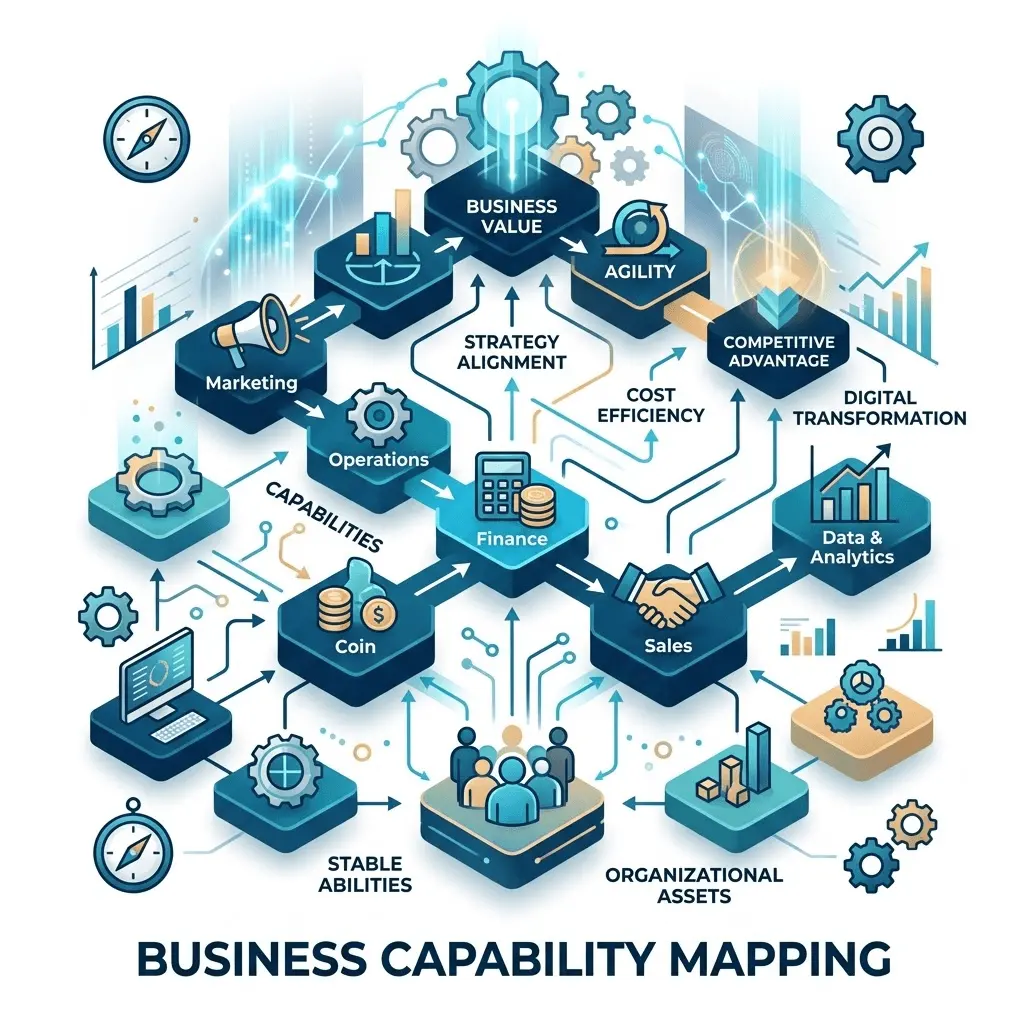
What is a Business Capability Map?
At its core, a business capability map is a visual representation of the stable, foundational abilities an organisation needs to execute its business model. Unlike an org chart (which shows people) or a process map (which shows workflows), a capability map focuses on outcomes.
Process
"Invoicing the customer"
Capability
"Billing Management"
While processes change frequently as technology evolves, capabilities remain remarkably consistent over time.
Why It Matters for Growth and Agility
1. Strategic Alignment
Too often, there is a "translation gap" between the boardroom and the IT department. Executives speak in terms of market share and revenue; IT speaks in terms of cloud architecture and APIs. A capability map acts as a common language. By mapping strategic goals directly to specific capabilities, leadership can clearly see which areas need investment to achieve the vision.
2. Eliminating Redundancy (and Saving Costs)
Organisations often suffer from "capability bloat." You might find three different departments using three different software tools for "Customer Relationship Management.
- The Benefit: Mapping reveals these overlaps.
- The Result: Rationalising your tech stack can save thousands in licensing fees and reduce operational complexity.
3. Informed Digital Transformation
Digital transformation isn't about buying the newest AI tool; it’s about enhancing the capabilities that provide value. A heat-mapped capability model allows you to identify:
- Critical Weaknesses: Where are we failing to deliver?
- Competitive Differentiators: Which capabilities make us unique?
- Investment Priorities: Where will £1 spent yield the highest return?
How to Get Started: The Three-Tier Approach
Building a map shouldn't be an exhaustive multi-year project. Start with a high-level view and drill down:
Commercial, Operations, Finance
Marketing, Sales, Supply Chain
Lead Generation, Inventory Planning
Using Capability Maps
Once you have your capability map, you can use it in a number of ways. Here are three ways capability maps can be used to drive transformation in your organisation.
1. The "Heat Map"
(Finding the Gaps)
This is the most common use. You take your map and overlay it with performance data using colours (Red, Amber, Green).
- Red: A capability that is critical to your strategy but currently failing (e.g., "Digital Payments" is slow and buggy).
- Green: A capability that is performing well and doesn't need immediate investment.
- Use case: It stops you from "sprinkling" your budget across every department and forces you to invest where it actually matters.
Benefit
Identify which capability areas are not meeting expectations
2. The "Translation Layer"
(Strategy to IT)
Executive leadership often says, "We need to be the most customer-centric brand in the UK." IT hears that and doesn't know whether to upgrade the database or build a new app.
- The Map's Role: You look at the "Customer Management" capability. You realise that to meet the goal, you need to improve "Real-time Personalisation." Now, IT has a specific target to build toward.
Benefit
Identify where investment needs to be made
3. Tech Stack Rationalisation
(Saving Money)
Companies of all sizes, especially those looking for quick growth often pay for five different tools that have overlapping functionality.
- Use case: Mapping your software applications to your capabilities. You might find that the Marketing team is using HubSpot, the Sales team is using Salesforce, and the Support team is using Zendesk—all for the same "Customer Data Management" capability. The map makes these expensive redundancies impossible to hide.
Benefit
Reduction in operating costs
The GA Plus Takeaway
In the UK’s current economic climate, efficiency is the name of the game. Business Capability Mapping isn't just an exercise for enterprise architects; it’s a vital tool for any leader who wants to ensure their resources are aligned with their ambition.
By shifting your focus from "Who does what?" to "What do we need to be great at?", you transform your organisation from a collection of silos into a streamlined, strategic machine.
LeanIX have some excellent starter templates for some industry sectors here:
Business Capability Map Examples & Templates